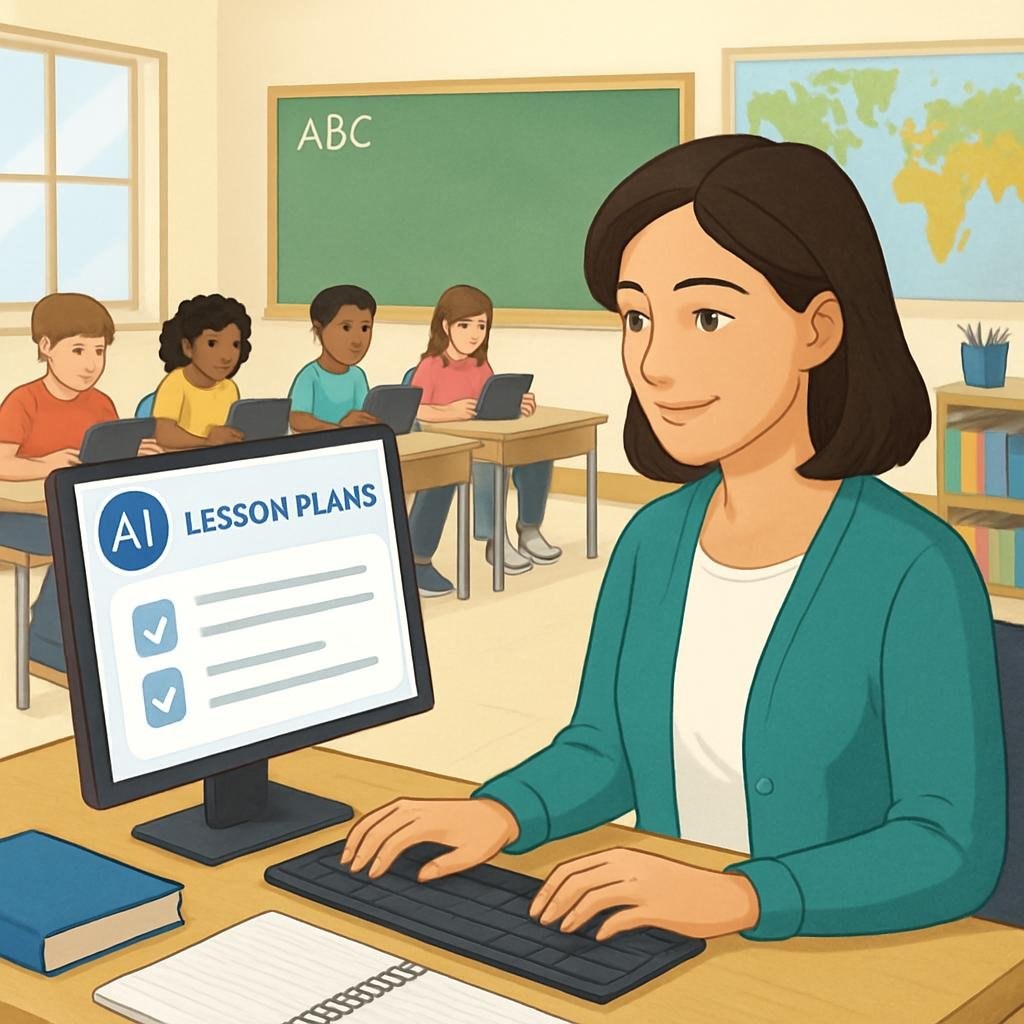
Teaching requires an extraordinary amount of preparation, creativity, and adaptability. Between developing lesson plans, reviewing assignments, supporting individual learners, communicating with families, and managing classroom responsibilities, educators often have more work than can comfortably fit into a typical school day. Artificial intelligence has introduced tools that may help with some of these tasks, giving teachers new ways to organize materials and explore instructional ideas.
However, using AI effectively requires more than entering a request and accepting whatever appears on the screen. Generated content can contain mistakes, overlook important context, or fail to match students' needs. Teachers who understand both the possibilities and limitations of these tools can use them as practical assistants while maintaining control over instructional decisions.
Starting With Clear Teaching Objectives
Before introducing an AI tool into a teaching routine, educators should identify the specific task they want to improve.
Some teachers may need help developing lesson outlines, while others want additional reading activities or more efficient ways to organize classroom resources.
The growing availability of AI for teachers creates opportunities to explore these needs, but selecting technology without a clear purpose can lead to unnecessary complexity.
A useful starting point is to identify repetitive responsibilities that consume considerable preparation time.
Teachers can then evaluate whether an approved tool provides meaningful assistance.
For example, generating a preliminary outline for a lesson may be helpful if the educator still reviews and adapts the content.
The objective is not to automate teaching itself.
Instead, AI should support tasks that allow teachers to devote more attention to instruction and student relationships.
Developing Lesson Plans More Efficiently
Lesson planning involves connecting curriculum expectations with learning activities, instructional materials, and assessment methods.
AI tools may help teachers brainstorm approaches or organize ideas into a structured sequence.
An educator preparing a science lesson might request several ways to explain a difficult concept.
A history teacher may explore different activities for comparing primary sources.
These suggestions can provide useful starting points, particularly when planning unfamiliar material.
However, generated lesson plans should never be accepted without review.
Teachers must confirm factual accuracy, alignment with curriculum requirements, and suitability for their students.
Timing is another consideration.
An activity that appears reasonable in a generated outline may require more classroom time than expected.
Experienced educators remain responsible for adapting suggestions to the realities of their classrooms.
Creating Differentiated Learning Materials
Classrooms include students with different reading abilities, background knowledge, and learning needs.
Preparing multiple versions of instructional materials can require substantial time.
AI may help teachers create preliminary adaptations of passages, instructions, or practice activities.
For example, an educator might request explanations of the same scientific concept at different levels of complexity.
Another teacher may generate additional examples for students who need more practice.
However, simplifying language should not automatically mean reducing intellectual expectations.
Students benefit from accessible explanations that preserve important ideas.
Teachers should also review adapted materials for accuracy and clarity.
Individual education plans, accessibility requirements, and professional judgment should guide decisions about accommodations.
AI can assist with preparation, but it cannot independently determine what a particular student needs.
Designing More Engaging Classroom Activities
Teachers regularly search for ways to make lessons more interactive.
AI can provide ideas for discussions, group activities, creative exercises, and practical demonstrations.
For example, a language arts teacher might request debate prompts connected to a novel.
A mathematics teacher could generate real-world scenarios that require students to apply a particular skill.
An elementary educator may explore age-appropriate games that reinforce vocabulary.
These suggestions can help overcome occasional planning challenges.
However, activities should be evaluated for educational value.
A creative exercise is useful only when it supports the intended learning outcome.
Teachers should also consider classroom resources, student maturity, and the time available.
The strongest activities combine thoughtful planning with an understanding of what motivates a particular group of learners.
Generating Practice Questions and Assessments
Creating assessments requires careful attention to learning objectives and difficulty levels.
AI tools may help educators draft multiple-choice questions, short-answer prompts, discussion questions, or practice exercises.
Teachers can request questions that assess different levels of understanding.
For example, some questions may focus on recalling information, while others require explanation, comparison, or application.
Generated assessments can save preparation time, but every question needs review.
AI may produce incorrect answer keys, ambiguous wording, or questions that do not accurately measure the intended skill.
Educators should also ensure that assessments reflect material students have actually studied.
A well-designed assessment provides meaningful information about learning rather than simply generating a grade.
Providing More Useful Student Feedback
Feedback helps students recognize strengths and understand how to improve.
However, reviewing large numbers of assignments can be time-consuming.
AI may assist teachers in developing feedback templates, organizing common observations, or suggesting ways to explain recurring mistakes.
For example, an educator might use an approved tool to draft general comments about essay organization or mathematical reasoning.
However, individualized feedback should reflect the student's actual work.
Teachers must verify that comments are accurate, constructive, and appropriate.
Sensitive student information should not be entered into unapproved systems.
Automated feedback can also miss creativity, effort, and context that a teacher recognizes through personal interaction.
The goal is to make feedback more timely and useful without removing professional judgment.
Supporting Classroom Communication
Teachers communicate regularly with parents, guardians, administrators, and colleagues.
Messages may involve classroom announcements, assignment reminders, event information, or general learning updates.
AI can help draft clear communications and adjust language for different audiences.
For example, a teacher may want to turn a lengthy classroom announcement into a concise newsletter paragraph.
Another may need assistance organizing information about an upcoming field trip.
Generated drafts should be reviewed for accuracy, tone, and completeness.
Teachers should avoid including confidential student details in tools that are not approved for handling that information.
Sensitive conversations about individual students require particular care.
AI may help with wording, but the educator remains responsible for communicating appropriately and maintaining trust.
Making Educational Content More Accessible
Accessibility is an important consideration when preparing classroom materials.
Students may benefit from alternative formats, clearer instructions, captions, or additional language support.
AI-assisted tools may help educators create initial versions of these resources.
For example, a teacher could generate a plain-language explanation of a complex instruction.
Speech recognition and text-to-speech applications may also support certain classroom activities.
However, automated accessibility features are not always accurate.
Captions may misrepresent specialized vocabulary, while translations can alter important meanings.
Teachers should verify materials before using them and follow applicable student support requirements.
Accessibility decisions should be informed by the needs of individual learners rather than assumptions about what technology can accomplish.
Using AI to Support Professional Development
Educators continually develop new skills throughout their careers.
AI can serve as a brainstorming resource when teachers explore instructional strategies, classroom routines, or unfamiliar educational concepts.
A teacher might request examples of formative assessment techniques or compare different approaches to collaborative learning.
These responses can introduce ideas worth investigating.
However, AI-generated explanations should not replace reliable professional resources.
Teachers should verify significant claims through credible educational research, established guidance, or qualified colleagues.
Professional development also benefits from discussion and shared experience.
AI may provide suggestions, but educators develop stronger judgment by evaluating those suggestions in the context of actual classroom practice.
Maintaining Academic Integrity in AI-Assisted Classrooms
Teachers increasingly need to explain appropriate AI use to students.
Clear expectations can help distinguish acceptable assistance from work that misrepresents a student's understanding.
For example, a teacher may permit AI-assisted brainstorming while requiring students to produce their own final analysis.
Another assignment may prohibit generative tools entirely because independent performance is the skill being assessed.
Policies should be understandable and consistent with school requirements.
Teachers may also design assignments that emphasize drafting, reflection, oral explanation, and evidence of learning.
These approaches can provide insight into student thinking.
AI-detection software should not be treated as definitive proof of inappropriate use.
Fair evaluation requires careful consideration of the assignment, available evidence, and school procedures.
Protecting Student Information and Privacy
Teachers handle information that requires responsible protection.
Student names, grades, learning needs, family circumstances, and classroom records should not be entered into unfamiliar AI systems without appropriate authorization.
Before using a tool, educators should understand school policies and the platform's data-handling practices.
Even when a system appears convenient, it may not be suitable for processing confidential information.
Teachers can often explore general instructional ideas without including identifying student details.
For example, a request for strategies to support reading comprehension does not necessarily require uploading individual student records.
Schools should provide clear guidance about approved platforms and permitted uses.
Privacy protection should be a routine part of instructional planning rather than an afterthought.
Recognizing When AI Is Not Appropriate
Not every teaching responsibility benefits from automation.
Students sometimes need encouragement, emotional support, or a conversation that reflects personal understanding.
Classroom conflicts, sensitive family situations, and important educational decisions require human judgment.
AI-generated suggestions may overlook cultural context, individual circumstances, or subtle interpersonal factors.
Teachers should also recognize that generated information can be inaccurate.
A confident explanation is not necessarily a correct one.
When using AI to prepare instructional content, educators should check important facts and evaluate whether the material is appropriate.
Technology should remain a resource rather than an authority.
Knowing when not to use AI is an important part of using it responsibly.
Developing a Sustainable AI Workflow
Teachers may find it useful to begin with one or two manageable applications rather than attempting to change every part of their routine.
For example, an educator might start by using an approved tool to brainstorm lesson activities or draft general classroom announcements.
After gaining experience, the teacher can evaluate whether the tool genuinely saves time.
Useful questions include whether the generated material requires extensive correction and whether it improves the final result.
Teachers should also consider the time needed to learn and maintain the technology.
A complicated process that creates additional work may not provide meaningful benefits.
Gradual experimentation allows educators to develop practical habits while avoiding unnecessary dependence on automated systems.
Keeping Teachers at the Center of Education
Artificial intelligence can help educators prepare lessons, develop classroom materials, explore instructional strategies, and organize certain administrative tasks.
However, its usefulness depends on thoughtful application.
Teachers understand their students, interpret learning needs, recognize classroom dynamics, and make decisions that automated systems cannot reliably replace.
AI-generated content should therefore be treated as a starting point requiring professional review.
Clear objectives, privacy safeguards, accurate information, and appropriate school policies are essential.
When educators use AI selectively and maintain control over important decisions, technology can support more efficient preparation while preserving the creativity, judgment, and personal relationships that make teaching effective.
