In 2026, the boundary between “creative writing” and “technical data” has almost entirely disappeared. For undergraduate students, the challenge is no longer just finding a library book; it is about navigating a sea of digital information to find a story worth telling. Whether you are studying in London, Sydney, or New York, the expectation for academic excellence has shifted toward a “data-first” mindset. This means using the same digital tools that tech experts use to track social media trends or website traffic to actually inform your next big paper.
Choosing a topic is the hardest part of any assignment because a weak foundation leads to a weak argument. However, when you use tech insights—like looking at what people are searching for or what is trending on platforms like iStaunch—you find subjects that are relevant to the real world. For those moments when your brain feels completely fried and data tools aren’t enough, looking through a curated list of informal essay topics can provide the creative spark needed to turn a dry data point into a compelling narrative. This blend of tech-driven research and human creativity is the secret to getting noticed by professors who have seen a thousand generic essays.
Why “Data-Driven” is the New Standard for Students
Traditional brainstorming usually involves staring at a blank page. Data-driven writing, however, starts with an investigation. By using digital tools to analyze “keywords” or “trending discussions,” you are essentially finding out what the world cares about right now. This makes your essay timely.
When you write about a topic that has high digital engagement, you aren’t just guessing; you are proving that your argument has merit in the current cultural or scientific landscape. For an undergraduate, this demonstrates a high level of “digital literacy,” a skill that is just as valuable as the writing itself in the modern job market.
The Student Tech Stack: Tools for Better Writing
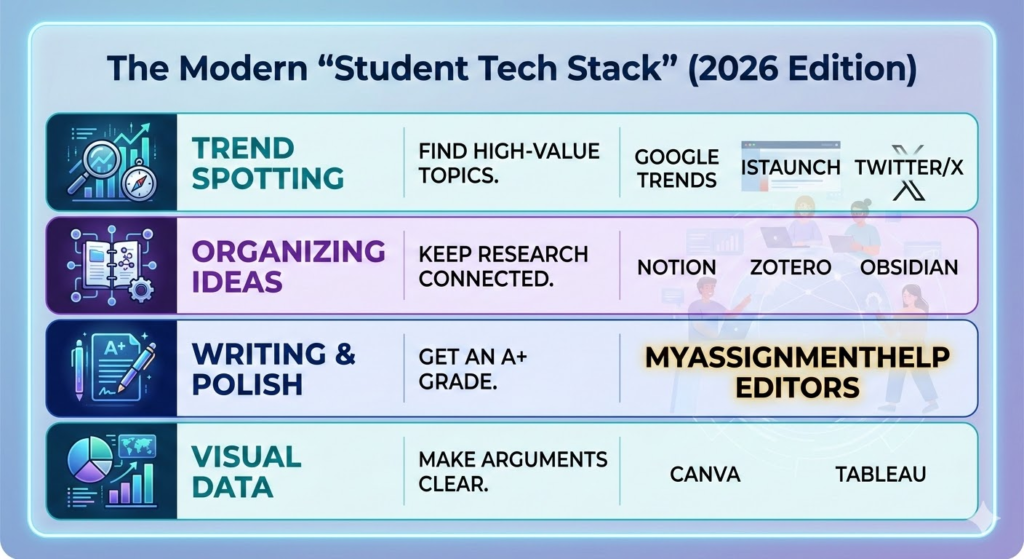
To write a winning essay, you need a workflow. It isn’t just about the word processor you use; it’s about the tools you use to validate your ideas before you even type the first word.
| Tool Category | Purpose for Students | Example Tools |
| Trend Analysis | Finding what is globally relevant | Google Trends, iStaunch Trackers |
| Organization | Managing citations and data points | Notion, Zotero |
| Linguistic Polish | Ensuring clarity and tone | MyAssignmentHelp Editorial Tools |
| Data Visualization | Making complex ideas easy to see | Canva, Lucidchart |
Bridging the Gap: From Raw Data to a Polished Draft
Once you have your data and your topic, the actual “writing” phase begins. This is where many students stumble. You might have the best data in the world, but if your transitions are clunky or your grammar is inconsistent, the data loses its power.
In the middle of a heavy semester, the workload can become overwhelming. This is where professional intervention becomes a strategic move rather than a last resort. To ensure your work meets the highest academic standards, utilizing MyAssignmentHelp essay editing services allows you to have a second pair of expert eyes on your work. They don’t just fix typos; they ensure your data-driven arguments flow logically and that your “global tone” remains consistent throughout the piece. This middle stage of the writing process is crucial because it transforms a “good” draft into a “first-page” quality submission.
How Tech Insights Help You “Rank” With Your Professor
While “ranking on Google” is for websites, “ranking with your professor” follows a similar logic. Professors look for:
- Originality: Is this a new take on an old problem?
- Authority: Did the student use credible sources?
- Clarity: Is the paper easy to read and follow?
By using tech insights to choose your topic, you automatically satisfy the “Originality” requirement. You aren’t writing the same essay on “Climate Change” that has been written for twenty years; you are writing about “The Impact of Blockchain on Carbon Credit Transparency,” a topic backed by current data.
The “Global Tone” and Why It Matters in 2026
The world is more connected than ever. An undergraduate in 2026 is often writing for a diverse audience. Avoid using local slang or idioms that someone in another country might not understand. A “global tone” is about being direct, clear, and inclusive. It means explaining your terms and ensuring that your logic is universal.
Data is the ultimate universal language. Numbers and trends don’t change based on your accent or your location. When you lead with data-driven insights, your writing becomes accessible to a global audience, making it far more likely to be shared or cited in academic circles.
Final Thoughts for the Modern Student
The journey from a blank screen to a finished, high-quality assignment is no longer a solitary one. By leveraging tech insights and digital tools, you can ensure your topics are relevant and your writing is impactful. Remember, the goal of data-driven writing isn’t just to finish the assignment—it’s to contribute something meaningful to the global conversation. Keep your tone clear, your data fresh, and never be afraid to seek professional editorial help when the stakes are high.
FAQ: Navigating Modern Academic Writing
Q: Can I use AI to write my whole essay if I have the data?
A: It is not recommended. While AI can help organize data, it lacks the “human touch” and critical thinking required for high-level academic work. Professors now use advanced tools to detect AI patterns, so your personal voice and human editing are your best defense.
Q: How do I know if a topic is “trending” or just a fad?
A: Look for sustained interest. If a topic has been discussed consistently for several months on tech blogs and news sites, it has “staying power.” If it disappears after two days, it’s a fad.
Q: Is professional editing considered cheating?
A: No. Professional editing is a standard practice in the academic and publishing world. It is a collaborative process that helps you improve your own writing skills by seeing how an expert refines your arguments and corrects your errors.
Q: How many data points do I need for a standard essay?
A: For a 1,500-word essay, aim for 3-5 strong, data-backed arguments. Quality always beats quantity; one well-explained data insight is better than ten random statistics.
About The Author
Hi, I’m Ruby Walker. With over a decade of experience in the higher education sector, I focus on helping undergraduate students navigate the increasingly complex intersection of technology and academic writing. As a senior strategist associated with MyAssignmentHelp, my mission is to bridge the gap between raw data and compelling storytelling.
